

Documentation Index
Fetch the complete documentation index at: https://v2-docs.exponent.finance/llms.txt
Use this file to discover all available pages before exploring further.
SY: Standardized Yield
Different DeFi protocols each use different token standards and interest mechanics. Before yield stripping can occur, Exponent wraps yield assets from these protocols into a common interface called SY (Standardized Yield). Each supported protocol has a dedicated SY program that handles minting, redeeming, depositing, and withdrawing under a single unified interface. Exponent has a generic SY adapter that supports a variety of yield sources from protocols like Meteora, Fragmetric, Jupiter Lend, and more, as well as specific SY adapters for Kamino Lend, marginfi, Jito Restaking, and Perena. Because every SY program exposes the same interface, the vault’s stripping logic is completely protocol-agnostic — it doesn’t need to know which yield source it’s working with. Once wrapped as SY, tokens can be stripped into PT (Principal Token) and YT (Yield Token). The relationshipvalue(1 PT) + value(1 YT) = value(1 SY) always holds — when it diverges on the market, arbitrage restores the balance.
The Exchange Rate
SY has an exchange rate that represents how much underlying base asset one SY token is worth. It grows over time as the underlying protocol accrues yield, and drives all minting, redemption, and pricing across Exponent:| Time | Exchange Rate | 100 SY is worth |
|---|---|---|
| Day 0 | 1.00 | 100 USDC |
| Day 90 | 1.025 | 102.50 USDC |
| Day 180 | 1.05 | 105.00 USDC |
| Day 365 | 1.10 | 110.00 USDC |
vault.currentSyExchangeRate — see Get Exchange Rate.
How SY Conversion Works
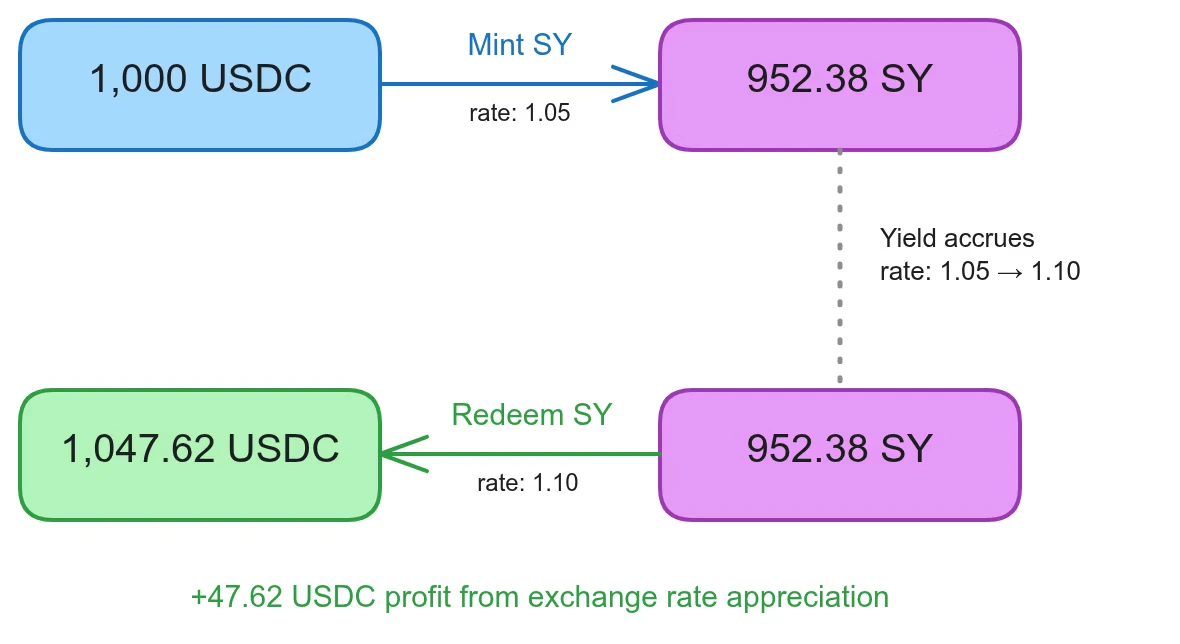
Strategy Vaults use the same protocol integrations (Kamino, Marginfi, Jito Restaking, Perena, Generic) through their
InterfaceType enum. See Token Entry for the vault-side mapping.PT: Principal Token
PT (Principal Token) is the fixed-rate side of a stripped yield position. Think of it as a zero-coupon bond: you buy it at a discount and redeem it at face value when it matures. The discount you get is your fixed return — locked in at the moment you buy, regardless of what the underlying yield does afterward. When SY is stripped, it splits into PT (capturing the principal) and YT (capturing the variable yield). PT holders are completely insulated from yield fluctuations.Key Properties
- Trades below face value before maturity
- Redeemable 1:1 for the underlying at maturity
- Price appreciates toward 1.00 as maturity approaches
- Fixed yield — insulated from variable rate fluctuations
How the Discount Works
PT always trades at a discount that reflects the market’s implied rate. The closer to maturity, the smaller the discount:| Days to Maturity | PT Price | You pay for 1,000 PT | At maturity you receive |
|---|---|---|---|
| 180 | 0.95 | 950 SY | 1,000 SY |
| 90 | 0.975 | 975 SY | 1,000 SY |
| 0 (maturity) | 1.00 | — | 1,000 SY |
YT: Yield Token
YT (Yield Token) is the variable-yield side of a stripped position. When SY is stripped, it splits into PT (capturing the principal) and YT. YT represents all the rewards that do not accrue to the principal. Because YT only represents the yield component, it costs a fraction of the full asset — but earns the same yield. This makes YT a leveraged bet on the underlying rate: if yield is higher than the market expects, YT holders profit disproportionately. If yield disappoints, losses are amplified too.Key Properties
- Leveraged yield exposure — amplified returns compared to holding SY directly
- Value decreases over time — less time remaining means less yield left to capture
- Yield accrues in real time — claimable as the exchange rate grows, not only at maturity
- Expires worthless — after final yield collection at maturity, YT has no residual value
How the Leverage Works
Suppose PT trades at 0.95. That means YT costs just 0.05 per unit — giving you 20x leverage on yield. Here’s what that looks like in practice:| If underlying earns | Holding 1,000 SY | Holding YT (cost: 50 SY) |
|---|---|---|
| 5% over 90 days | 50 SY profit | ~47.6 SY profit (95% return) |
| 2% over 90 days | 20 SY profit | ~19 SY profit (38% return) |
| 0% | 0 | 0 — lost 50 SY cost |
Next Steps
Pricing & Math
Formulas for PT and YT pricing, implied APY, leverage, and time decay
Core SDK Quickstart
Start building with the Core SDK